
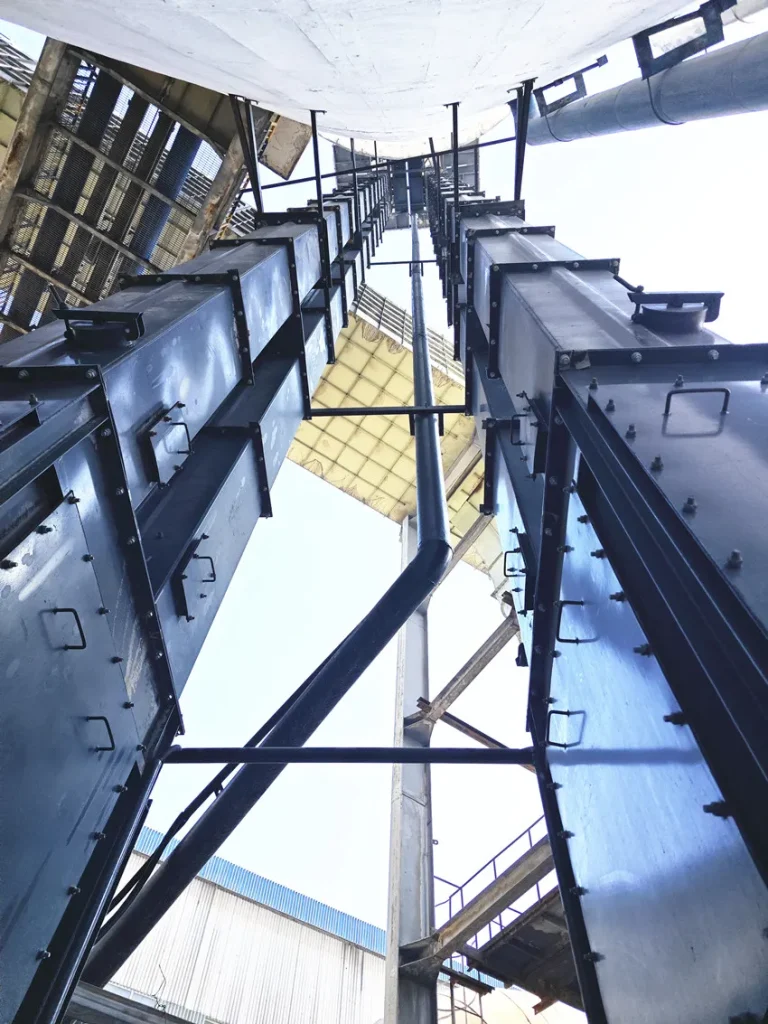
Choosing the right bucket elevator is important for building a reliable bulk material handling system. The correct equipment depends not only on the required capacity and lifting height, but also on the characteristics of the material being conveyed.
A suitable bucket elevator should match the material, required throughput, lifting height, and working conditions of the application. This guide outlines the key factors to consider before selecting a bucket elevator.
1. Identify the Material to Be Conveyed
The first step is to understand the material that the bucket elevator will handle.
Different materials can require different elevator configurations. Important information includes:
- Material type
- Bulk density
- Particle size
- Moisture content
- Material temperature
- Abrasiveness
- Flowability
For example, grain, fertilizer, cement, biomass, and mineral materials can have very different conveying characteristics.
Material density is particularly important because it affects the relationship between volumetric flow and the required tonnes-per-hour capacity.
Providing accurate material information allows the manufacturer to recommend suitable buckets, belt or chain configuration, and other components.
2. Determine the Required Capacity
Capacity is one of the most important parameters when selecting a bucket elevator.
It is commonly specified in tonnes per hour (t/h) or cubic metres per hour (m³/h).
When determining the required capacity, consider both the normal material flow and the expected operating conditions. The elevator should be selected with an appropriate design margin rather than being expected to operate continuously at its absolute maximum capacity.
Capacity is influenced by several factors, including:
- Bucket volume
- Bucket spacing
- Elevator speed
- Filling efficiency
- Material density
If you know the required capacity but are unsure what bucket size or elevator speed is appropriate, HBTY can help determine a suitable configuration.
3. Consider the Lifting Height
The required lifting height determines the overall length and configuration of the bucket elevator.
When requesting a quotation, it is useful to provide the actual distance between the required inlet and discharge points rather than simply describing the elevator as “20 metres high.”
Other installation information may also be important, including:
- Inlet elevation
- Discharge elevation
- Available installation space
- Connection points
- Foundation conditions
- Headroom
For taller elevators, proper alignment and structural stability become increasingly important.
4. Choose Between Belt and Chain
One of the main choices is whether the elevator should use a belt or chain as the traction element.
Belt Bucket Elevator
Belt bucket elevators are widely used for many bulk materials, including grain, feed, fertilizer, powders, and other free-flowing materials.
Typical advantages include:
- Smooth operation
- Relatively low noise
- High conveying speed
- Suitable for many granular materials
- Straightforward maintenance
The belt must still be selected according to the material, capacity, temperature, and operating conditions.
Chain Bucket Elevator
Chain bucket elevators are commonly considered for heavier-duty applications where higher mechanical strength or more demanding operating conditions are required.
They can be suitable for applications involving heavier or abrasive materials and, depending on the design, higher material temperatures.
The choice between belt and chain should therefore be based on the complete application rather than on capacity alone.
5. Select the Appropriate Bucket Design
The bucket is directly responsible for lifting the material, so its size and design have a significant effect on elevator performance.
Important considerations include:
- Bucket volume
- Bucket shape
- Bucket spacing
- Material characteristics
- Elevator speed
- Discharge requirements
A bucket should be able to fill effectively and discharge the material with minimal carryback.
Bucket material is also important. Depending on the application, buckets may be manufactured from carbon steel, stainless steel, engineering plastics, or other suitable materials.
The correct choice depends on the material being conveyed, temperature, wear requirements, and operating environment.
6. Consider the Complete Application
A bucket elevator should not be selected as an isolated piece of equipment.
The feeding system, upstream conveyor, downstream equipment, and installation environment can all affect elevator performance.
Before selecting the equipment, consider:
- How material enters the elevator
- Where the material will be discharged
- Indoor or outdoor installation
- Operating hours
- Ambient conditions
- Available maintenance space
A consistent material feed is especially important. Poor feeding conditions can lead to uneven bucket loading, material accumulation, spillage, and reduced conveying performance.
There is no single bucket elevator configuration that is suitable for every bulk material handling application.
Two projects may have the same capacity and lifting height but still require different equipment because of differences in material density, temperature, particle size, abrasiveness, or operating conditions.
At HBTY, we manufacture bucket elevators for different bulk material handling applications. Our equipment can be configured according to the material characteristics, required capacity, lifting height, and working conditions of each project.
If you are planning a new bulk material handling system or replacing an existing elevator, send us your material, capacity, lifting height, and operating requirements. We can help evaluate a suitable bucket elevator configuration for your application.